
.jpg)
There's a quiet crisis playing out across lecture halls, clinical placements, and campus careers fairs. Students who have worked hard for their qualifications are stepping into interviews and professional environments - and freezing.
Not because they lack knowledge. Because they lack confidence.
The gap between academic achievement and workplace readiness has widened considerably in recent years. Employers consistently cite communication skills, resilience, and professional presence as the qualities most missing from graduate candidates. Yet these are precisely the skills that are hardest to develop through lectures, reading lists, and exams alone.
Research from the World Economic Forum's Future of Jobs Report 2025 found that 63% of employers identify skill gaps as their primary barrier to business transformation. And the skills they're referring to aren't technical ones, they're human ones. According to the NACE Job Outlook 2025, there's a 30% gap between how graduates rate their own professionalism and how employers see them.
Building confidence in students, then, isn't a pastoral nicety. It's a core educational responsibility, and it’s one that demands more than encouragement.
Why Confidence is a Core "Human Skill"
It's worth being specific about what we mean by confidence in a learning context. This isn't about bravado or the ability to walk into a room and dominate. Real confidence is something more nuanced: the willingness to try, to be observed, to receive feedback, and to try again.
In that sense, confidence is less a personality trait and more a practised behaviour. And it underpins nearly every other soft skill educators are trying to develop.
A student who lacks confidence won't speak up in group work. They won't ask questions in placement. They won't handle interview questions with composure, even if they could answer them correctly on paper.
This is why the World Economic Forum consistently ranks resilience, self-efficacy, and communication among the most critical human skills for the coming decade. Technical skills can be taught through instruction, confidence has to be practised in realistic, low-stakes environments.
5 Strategies for Building Confidence in the Classroom
There's no single intervention that builds confident students overnight. But there are evidence-backed approaches that, used consistently, make a measurable difference. Here are five that are increasingly being embedded into forward-thinking curricula across higher and further education.
1. Create a "Safe to Fail" Environment
Confidence collapses when the cost of failure feels too high. Students who worry about embarrassing themselves in front of peers, or being judged by assessors, default to silence and risk avoidance. This protects their ego in the short term, but it fundamentally limits their development.
Creating a psychologically safe learning environment means actively decoupling practice from performance judgement. Students should have spaces to try things out, get it wrong, and try again without those attempts being recorded as assessment. Lowering the stakes in this way boosts growth.
This principle is embedded in the design of simulation-based learning, where learners practise high-stakes conversations - from clinical interactions to job interviews - in a private, judgment-free space before ever facing them in the real world.
2. Implement Peer-to-Peer Feedback Loops
One of the most effective ways to build self-awareness, which is a cornerstone of confidence, is to put students in the position of both giving and receiving feedback. When a student learns to observe and articulate the communication behaviours of their peers, they simultaneously develop the language and awareness to reflect on their own.
Structured peer feedback, when well-facilitated, builds objectivity. Students begin to understand that feedback is information, not judgement - a mindset shift that directly supports confidence in high-pressure situations. It also develops the kind of constructive communication skills that employers consistently rate as high-priority.
3. Use Scenario-Based Learning (SBL)
Scenario-based learning places students inside realistic simulations of the situations they'll face in their careers. Whether that's a difficult patient interaction, a workplace conflict, or a high-pressure public presentation, the principle is the same: practise the real thing before the real thing counts.
The research is clear that this approach works. Repeated exposure to realistic scenarios, with immediate feedback, accelerates skill development and reduces performance anxiety. Students who have 'been there before', even in a simulated context, carry a measurable confidence advantage into the real situation.
This is particularly powerful in healthcare education, where students preparing for clinical communication face enormous pressure. Bodyswaps' healthcare simulations allow nursing and allied health students to navigate complex patient conversations, including emotionally charged and ethically difficult scenarios, before setting foot on a ward.
4. Encourage Reflection and Self-Observation
Confidence isn't just about doing, it's about understanding what you did and why it worked (or didn't). Self-observation is a critical part of this loop.
When students can see themselves as others see them, whether through video feedback, AI-generated insights, or structured self-assessment, they gain a more accurate picture of their actual performance. Often, this is more positive than they expected. Many students are far more capable than their self-doubt suggests. Seeing the evidence of this directly is one of the most powerful ways to shift self-belief.
Bodyswaps' titular "body-swap" feature enables precisely this. After completing a simulation, learners can inhabit the perspective of the other person in the conversation, observing their own body language, tone, and presence from the outside. It's a level of self-awareness that traditional roleplay simply cannot offer.
5. Scaffolded Practice for High-Anxiety Tasks
For tasks that generate particular anxiety, like public speaking, interviews, clinical assessments, a scaffolded approach is far more effective than expecting students to perform under pressure from the outset. This means breaking the task into component parts and practising each one in isolation before combining them. A student preparing for job interviews, for example, might start with managing the anxiety itself, then move to structuring answers, then to body language, before tackling a full practice interview.
Similarly, students developing presentation skills might first focus on vocal projection, then structure, then delivery, before combining them in a full simulation. Each step builds the foundation for the next, and each small success contributes to a growing sense of capability.
Building Confidence for the Job Market
All of the above matters enormously in the classroom, but the real test of student confidence comes when they enter the job market. This is where the stakes are highest, and the gap between confident and uncertain candidates is most visible to employers.
Careers advisors and employability teams are increasingly being asked to do more than signpost opportunities. They're being asked to help students develop the interpersonal skills and self-assurance that will actually get them hired and keep them progressing once they are.
Mastering the Art of the Interview
Interview anxiety is one of the most commonly reported barriers to graduate employability. Students who know their subject deeply can still stumble badly in an interview setting if they haven't had adequate practice. The format itself (being evaluated by strangers, under time pressure, while trying to present your best self) is one of the most nerve-wracking experiences in a professional setting.
The answer isn't reassurance, though. It's repetition. The more times a student has navigated a realistic interview conversation, the less novel and threatening it feels. Anxiety diminishes not through avoidance but through exposure, specifically, through repeated practice that builds familiarity and competence.
Bodyswaps' interview preparation modules allow students to practise exactly this, with AI-driven interviewers who adapt to responses, provide immediate feedback, and allow unlimited repeat attempts. The result is students who arrive at real interviews having already 'done it' dozens of times.
Developing Professional Presence and Communication
Beyond answering questions well, employers assess something harder to define: presence. How does this person carry themselves? Do they make eye contact? Is their communication clear and direct? Do they listen actively, or wait for their turn to speak?
These signals - body language, vocal tone, pacing, active listening - are read almost instantly, and they significantly shape hiring decisions. They're also learnable. But they require a different kind of practice than most curricula provide.
Modules like Growth Mindset and Resilience and Workplace Communication Essentials in the Bodyswaps library specifically target these behaviours - giving students structured practice in the elements of professional presence that employers value but often can't articulate.

How Technology Accelerates Confidence Building
What makes immersive simulation genuinely different from traditional learning methods isn't just the technology. It's the combination of realism, repetition, and feedback that technology enables.
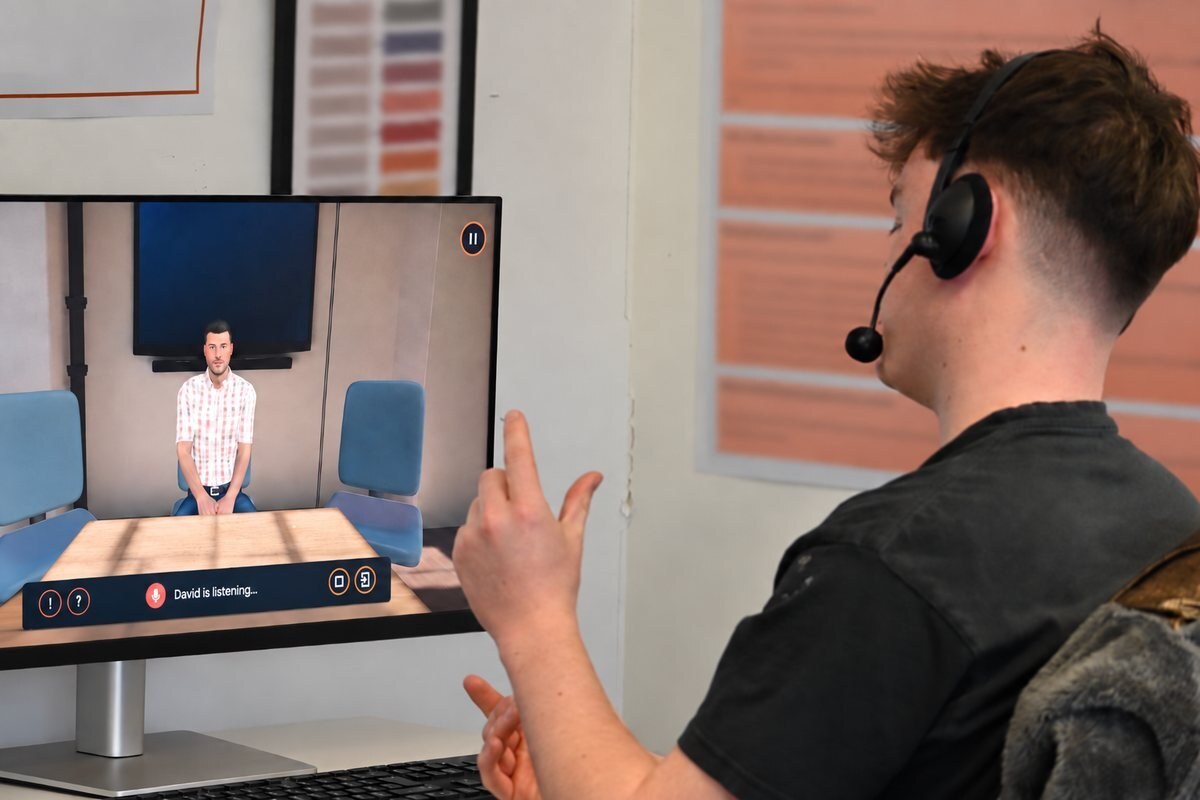
When a student uses Bodyswaps, they're not watching a video about how to handle a difficult conversation. They're actually having one, with an AI character who responds naturally to what they say, escalates or de-escalates based on their choices, and provides personalised feedback on their communication behaviours at the end.
This matters for confidence in a specific way: students build genuine self-efficacy, not just knowledge of what they're supposed to do. They experience themselves handling the situation, and that experience stays with them.
For educators and curriculum leaders exploring how this works in practice, the Bodyswaps roleplays offer a direct experience of the platform with no specialist hardware required.
Real-World Impact: From Anxious Student to Confident Professional
The evidence for immersive simulation as a confidence-building tool is no longer anecdotal. Across higher education, further education, and healthcare training, institutions using Bodyswaps are documenting measurable shifts in student self-assurance and professional readiness.
At Salford Business School, students using Bodyswaps reported significant improvements in personal confidence and digital literacy, with academic staff noting a visible difference in how students carried themselves in assessed presentations and group work.
At Sandwell College, the integration of Bodyswaps into employability programmes helped students develop the professional communication skills and interview confidence that had previously been a barrier to progression. The college documented improvements not just in student self-assessment scores, but in actual employment outcomes.
In healthcare training specifically, the impact on clinical communication confidence has been particularly striking. Nursing students and allied health professionals who have practised difficult conversations - breaking bad news, navigating angry patients, communicating across cultural differences - in a safe environment arrive at placements better prepared and noticeably more composed.
The Brunel University nursing associates case study offers a detailed look at how this plays out in practice, with learners describing the simulation experience as transformative in terms of their readiness for real patient interactions.

Investing in Student Potential
Confidence isn't a bonus outcome of good education. It's the mechanism through which everything else a student has learned gets expressed in the world.
The good news is that confidence is developable. It responds to the right conditions: safe practice environments, meaningful feedback, realistic scenarios, and the opportunity to observe and understand one's own performance. These aren't conditions that traditional education has always been well-equipped to provide, but they are exactly what immersive simulation makes possible at scale.
For educators and employability leaders looking to close the confidence gap, the question isn't whether to act, the question is how.
Ready to see what this looks like in practice? Try Bodyswaps for free.
Practice makes confident
