
.jpg)
Soft skills such as communication, empathy, leadership and conflict management are essential in healthcare, education and modern workplaces. Yet they have historically been difficult to teach and assess at scale. Traditional approaches rely on workshops, peer roleplay or static e-learning. These methods often lack realism, consistent feedback and meaningful practice.
AI-powered conversation simulations are changing this. Learners can now practise realistic workplace conversations with AI-driven characters and receive immediate, personalised feedback on how they communicate.
This article explains how AI improves soft skills training, what the AI actually evaluates during a conversation, and why AI feedback can be more effective than traditional roleplay or static digital training.
Why soft skills are hard to train
Soft skills involve judgement, behaviour and emotional intelligence. Unlike technical knowledge, they cannot be mastered by reading a guide or watching a video.
Effective training requires:
- Practice in realistic situations
- Feedback on communication behaviours
- Opportunities to reflect and try again
In many organisations, this is difficult to achieve consistently. Instructor-led roleplay is time intensive and subjective. E-learning modules explain concepts but rarely allow learners to practise conversations.
AI-based simulations address this gap by providing scalable, repeatable practice with structured feedback.

How AI improves soft skills training
AI enables learners to practise conversations in realistic scenarios while analysing how they communicate. AI training systems can evaluate three main elements of learner performance.
1. What the Learner Says (Speech and Language)
AI can analyse spoken or written responses to assess communication clarity, tone and structure.
Examples of elements evaluated include:
- Use of clear explanations
- Avoidance of defensive or dismissive language
- Appropriate questioning techniques
- Professional tone
Example feedback
“You provided useful information but did not acknowledge the patient’s concern first. Try opening with empathy before explaining the procedure.”
2. The Choices Learners Make in Conversations
Many training simulations require learners to make decisions during a conversation. For example, choosing how to respond when someone is upset, confused or resistant.
AI can evaluate:
- Decision quality
- Alignment with communication frameworks
- Whether responses escalate or de-escalate situations
Example feedback
“You moved quickly to problem solving. In emotionally sensitive situations, acknowledging feelings first can help build trust before offering solutions.”
3. Emotional Intelligence and Empathy
Some AI training systems analyse conversational patterns associated with empathy and rapport.
Signals may include:
- Acknowledging emotions
- Active listening
- Supportive language
- Respectful phrasing
Example feedback
“You addressed the issue directly but missed an opportunity to validate the employee’s frustration. Adding a brief acknowledgment can strengthen psychological safety.”
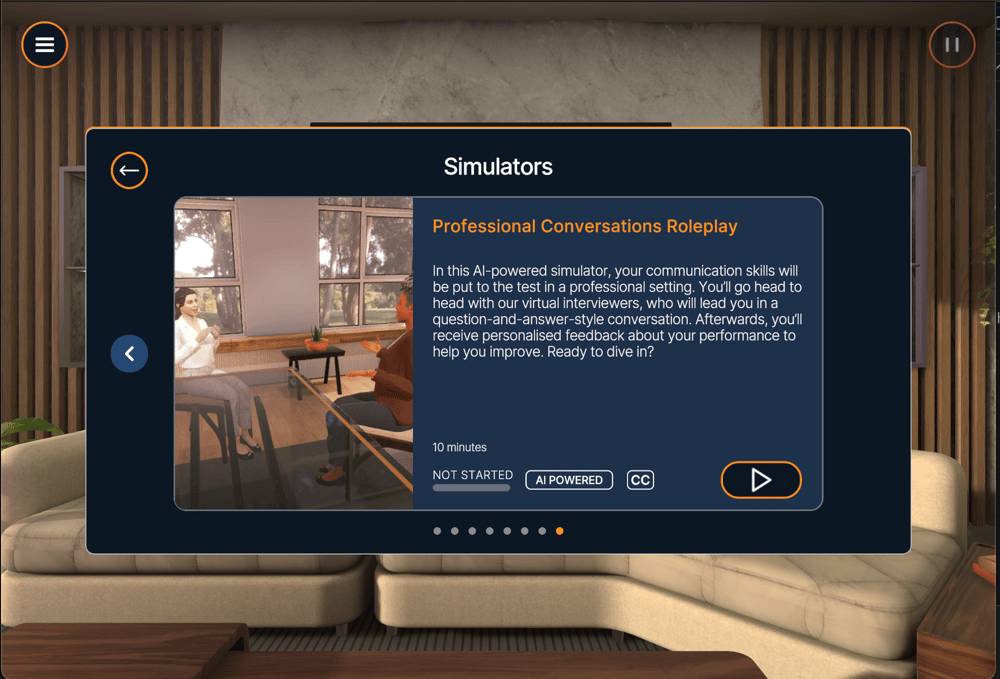
Realistic practice through AI roleplay
One of the most powerful features of AI-powered training is the ability to practise conversations repeatedly.
Learners can engage in realistic scenarios such as:
- Delivering difficult feedback to a colleague
- Handling a distressed patient or student
- Managing conflict within a team
- Leading a performance conversation
Unlike scripted roleplay, AI characters respond dynamically based on what the learner says. This creates a more authentic interaction where communication choices influence the direction of the conversation.
For example, if a learner becomes overly directive or dismissive, the simulated character may become defensive. If the learner demonstrates empathy and clarity, the conversation may progress more constructively.
Examples of AI feedback learners receive
AI feedback is most valuable when it is specific, structured and actionable. Instead of generic comments, learners receive detailed guidance on how their communication could improve.
Common feedback categories include:
Empathy
“You explained the process clearly, but the patient’s anxiety was not acknowledged. Consider briefly recognising their concern before providing information.”
Listening and Understanding
“You asked several questions in a row without summarising the patient’s response. Reflecting what you heard can help demonstrate active listening.”
Clarity
“Your explanation contained technical terminology that may confuse non-experts. Try simplifying the language.”
Conversation Structure
“You moved directly to solutions. In coaching conversations, asking exploratory questions first often leads to better outcomes.”
Because the feedback is immediate, learners can apply it in a second attempt and observe how the conversation changes.
Why AI training can be more effective than traditional roleplay
AI simulations address several limitations of traditional soft skills training.
Consistent Feedback
Human facilitators may provide valuable insights but feedback quality varies. AI systems can apply consistent evaluation criteria aligned with communication frameworks.
Safe Practice Environment
Learners often feel uncomfortable making mistakes in front of colleagues. Practising with AI reduces social pressure and encourages experimentation.
Unlimited Repetition
In workshops, roleplay opportunities are limited. AI simulations allow learners to practise multiple times until they improve.
Scalable Assessment
AI can evaluate communication behaviours across large cohorts, supporting workforce-wide training programmes.
Evidence From Learning Science
Several principles from learning science explain why AI-based simulations are effective for soft skills development.
Deliberate practice
Research shows that skill development requires repeated practice with targeted feedback. AI simulations allow learners to repeat challenging conversations until they improve.
Experiential learning
Learning is strengthened when individuals actively engage in realistic scenarios rather than passively consuming information.
Immediate feedback
Timely feedback improves skill acquisition by helping learners adjust behaviour while the experience is still fresh.
Structured assessment
Well-designed AI evaluation frameworks can improve consistency and transparency in communication skills assessment.
While AI should not replace human coaching entirely, it can significantly expand access to high-quality practice and feedback.

Where AI soft skills training is used today
AI-powered conversation simulations are increasingly used in sectors where communication quality is critical.
Common applications include:
- Healthcare communication training
- Leadership and management development
- Customer service training
- Higher education employability skills
- Job interview preparation
- Conflict resolution and difficult conversations
In healthcare education, for example, learners can practise patient communication scenarios such as explaining procedures, handling emotional distress or responding to concerns.
In leadership development, managers can rehearse performance conversations or practise giving constructive feedback.
The future of communication skills training
AI is not simply digitising traditional roleplay. It is creating new ways to practise and assess human communication skills at scale.
As AI models improve, training simulations are becoming more adaptive, more realistic and better at identifying nuanced communication behaviours.
For organisations responsible for preparing professionals to communicate effectively, AI-enabled practice environments offer a practical way to deliver consistent, scalable and evidence-informed soft skills training.
FAQ: AI and Soft Skills Training
How does AI improve soft skills training?
AI improves soft skills training by allowing learners to practise realistic conversations and receive immediate, structured feedback. AI systems can analyse communication behaviours such as empathy, clarity and listening, helping learners understand how their responses affect the outcome of interactions.
Can you practise conversations with AI?
Yes. AI conversation simulations allow learners to practise workplace scenarios such as giving feedback, managing conflict or communicating with patients or customers. The AI character responds dynamically based on what the learner says, creating a realistic interaction.
What does AI evaluate in communication training?
AI-based communication training typically evaluates:
- Clarity and tone of language
- Empathy and emotional intelligence
- Questioning and listening behaviours
- Decision-making during conversations
- Overall communication effectiveness
These evaluations are used to generate personalised feedback for learners.
Is AI feedback better than human roleplay feedback?
AI feedback is not necessarily better than human feedback, but it offers several advantages. It is consistent, immediate and scalable, allowing learners to practise repeatedly. Human coaching can still play an important role in deeper reflection and development.
What is AI roleplay in training?
AI roleplay is a training method where learners practise conversations with AI-driven characters in simulated scenarios. The AI responds in real time and provides feedback on communication behaviours, helping learners develop essential workplace skills such as empathy, leadership and conflict management.
