
.jpg)
Bodyswaps and VirtualSpeech both use AI-powered roleplay to support communication skills development. The differences lie in breadth or use cases, depth of pedagogical frameworks and institutional-readiness. Let’s break it down.
Who this comparison is for?
This comparison is for institutions that need to:
- Deliver curriculum-aligned soft skills training across cohorts, courses, or departments
- Support educators with limited time and resources
- Ensure safe, consistent AI-enabled learning experiences
- Measure impact from individual learner to class and institution level
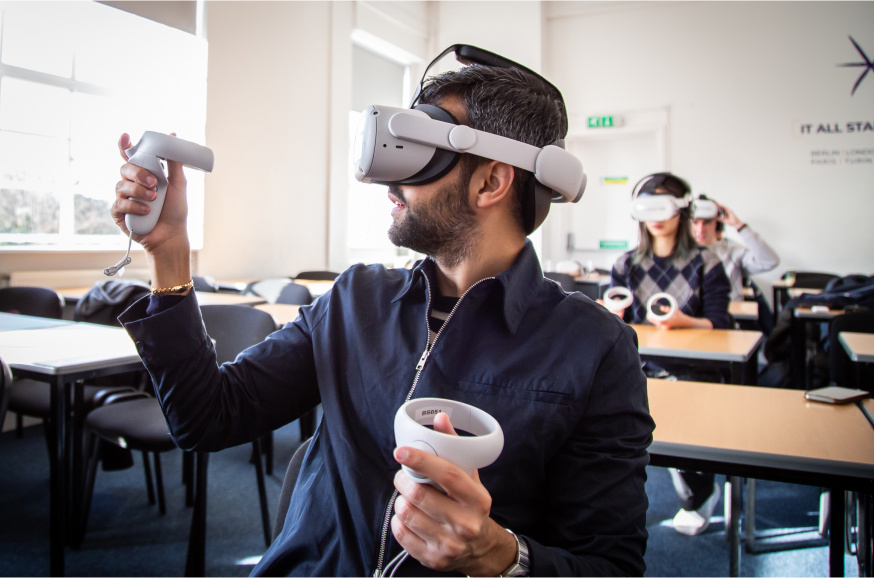
Two approaches to building soft skills
Both Bodyswaps and VirtualSpeech enable learners to practise communication skills through AI-driven conversation. However, they are built around different assumptions about how roleplay fits into learning and assessment.
Learning journeys vs standalone simulations
Bodyswaps
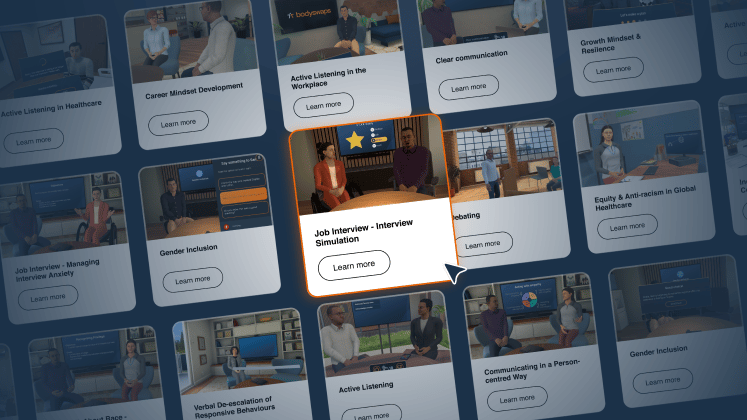
In Bodyswaps, educators author pathways: structured learning journeys that bring together preparation, practice, and assessment into a single, reusable flow.
Pathways typically combine:
- Off-the-shelf guided learning units that teach learners the skills, broken down in a scaffolded way, before practice
- Customisable AI-powered roleplay for applied skill development
- Customisable reflection, quizzes, and questionnaires to support assessment and insight
Over 2,000 pathways have been created by educators across employability, healthcare, business, and engineering disciplines.
Educators can reuse, adapt, and deploy these pathways across cohorts and programmes, ensuring consistency while reducing preparation time. They access learning performance data at individual and class level and generate evidence to support quality assurance, accreditation, and curriculum improvement.
VirtualSpeech
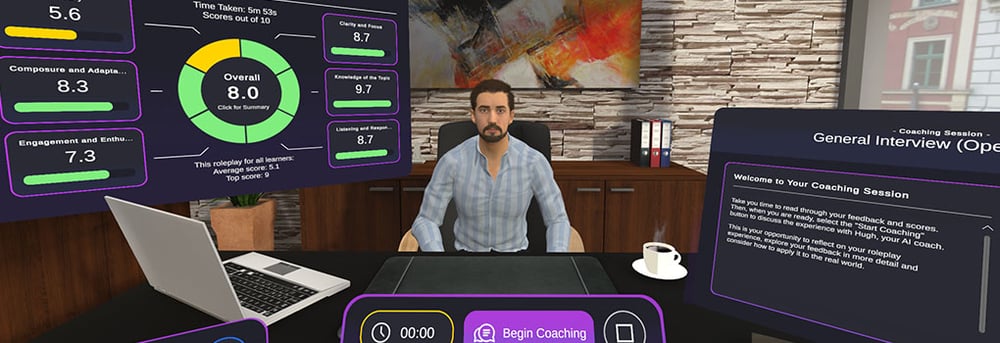
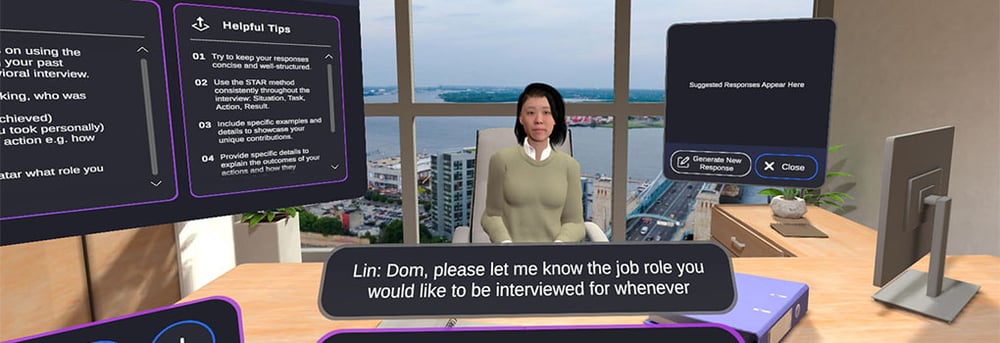
VirtualSpeech provides AI-powered roleplay scenarios designed to help learners practise communication skills across a wide range of professional contexts.
The platform offers a library of predefined roleplay templates, such as interviews, difficult conversations, sales, and customer service, with an emphasis on repeated conversational practice and feedback.
VirtualSpeech is primarily oriented around individual simulation experiences and does not include integrated learning modules, educator-defined learning pathways, or built-in assessments that combine preparation, practice, and evaluation into a single flow.
 Source: VirtualSpeech
Learner experience
|
Bodyswaps |
VirtualSpeech |
|
|
Skills learning |
Structured learning simulation mapped to learning objectives |
Preparation limited to traditional e-learning |
|
Practice |
Conversational AI roleplay with feedback and coaching |
Conversational AI roleplay with feedback and coaching |
|
Reflection & assessment |
Quizzes and self-reflection questionnaires integrated into the learning flow |
Limited or learner-only reflection |
Platform alignment by deployment goals
Different platforms align with different institutional needs and deployment models.
Choose VirtualSpeech if your deployment is centred on standalone simulations where the primary goal is individual practice or short-term pilots.
Choose Bodyswaps if your institution requires curriculum-integrated soft skills training supported by structured learning journeys, assessment, and scalable deployment.
 Source: VirtualSpeech
Why institutions evaluate beyond individual practice
For the 300+ institutions that have chosen Bodyswaps, soft skills training is rarely about a single interaction. It involves:
- Preparing learners before practice
- Supporting safe, repeatable application of skills
- Assessing progress over time
- Providing educators and institutions with meaningful insight
The way AI roleplay is embedded within a broader learning framework has a significant impact on scalability, educator workload, and outcome visibility.

