
.jpg)
The interview & communication skills gap, in six numbers
01A ranked comparison for higher and further education leaders and educators
It's 9pm the night before a first-round graduate interview, and a final-year student is practising answers to their bathroom mirror because there's no one else around. Their university's careers adviser ran eight mock interviews that week and still has thirty students on a waiting list.
Meanwhile, at a further education college, a lecturer is trying to work out how to give an entire cohort of health and social care students practice at handling a difficult conversation with a patient's family, before their first placement, without pulling in an actor for every session.
Both problems have the same fix: repeated, realistic practice, on demand, without needing a human roleplay partner every time. That's what AI roleplay training promises. We compared six of the best-known tools, Ovation, Yoodli, VirtualSpeech, Virti, Mursion and Bodyswaps, on how well they actually deliver interview practice and difficult-conversation training for students, so you can skip the demo calls and go straight to the shortlist.
Quick picks: which tool for which job
|
If you need... |
Start with |
|---|---|
|
Public speaking confidence, with interview practice as a bonus |
Ovation |
|
A free or near-free way to polish delivery for one person |
Yoodli |
|
A broad scenario library at a lower price than enterprise tools |
VirtualSpeech |
|
Healthcare-heavy simulation for clinical or enterprise training |
Virti |
|
High-stakes leadership or DEI conversation training, budget no object |
Mursion |
|
One platform for interview practice and difficult-conversation training, embedded across your whole curriculum, at any scale |
Bodyswaps |
Why this list exists
The need is well documented. A JDP survey of over 2,000 people (2020) found 93% had experienced interview-related anxiety. NACE's 2024–25 research puts the gap between how employers and students rate graduate leadership and professionalism at close to 30 percentage points. And Cengage Group's 2025 Graduate Employability Report found 48% of 2025 graduates didn't feel ready to apply for entry-level jobs, in the tightest entry-level market in five years.
The same gap follows students into the workplace. A Harris Poll (2018) found 69% of managers are often uncomfortable communicating with their own staff, and separately, Bravely's research (2019, via CNBC Make It) found 70% of employees avoid difficult conversations at work altogether, exactly the kind of conversation today's students will be having within a few years of graduating. LinkedIn's 2025 Workplace Learning Report found 71% of L&D professionals are already exploring or using AI for exactly this kind of practice.
When 93% of candidates feel anxious before an interview, and employers rate graduate professionalism almost 30 points below how graduates rate themselves, the issue isn't motivation. It's practice.
Does the practice actually help? PwC's 2020 study of enterprise VR training (with Talespin, supported by Oculus for Business) found learners were 40% more confident to act on what they'd learned than classroom-trained peers, and 35% more confident than e-learning-trained peers.
Separately, peer-reviewed randomised trials of Virtual Reality Job Interview Training found that practising with an AI interviewer improved real interview performance and the odds of a job offer, though it's worth noting those particular trials were run with jobseekers facing additional barriers to employment, such as serious mental illness or autism, using a desktop simulation rather than headset VR, so treat the effect size as encouraging rather than universal.
How we evaluated each tool
We looked at what actually matters to an institution or L&D team deploying a tool at scale, rather than to a single learner trying it out alone, using five questions:
- Does it combine preparation, practice and feedback, or just drop learners into a conversation?
- Does it work on any device, or only in VR (which excludes learners without a headset)?
- Does it cover both interview practice and workplace conversations, e.g. feedback or conflict?
- Does it report at class, cohort or team level, or only back to the individual learner?
- What does it actually cost, and at what scale?
The 6 tools, ranked
1. Ovation — best for public speaking confidence with interview practice
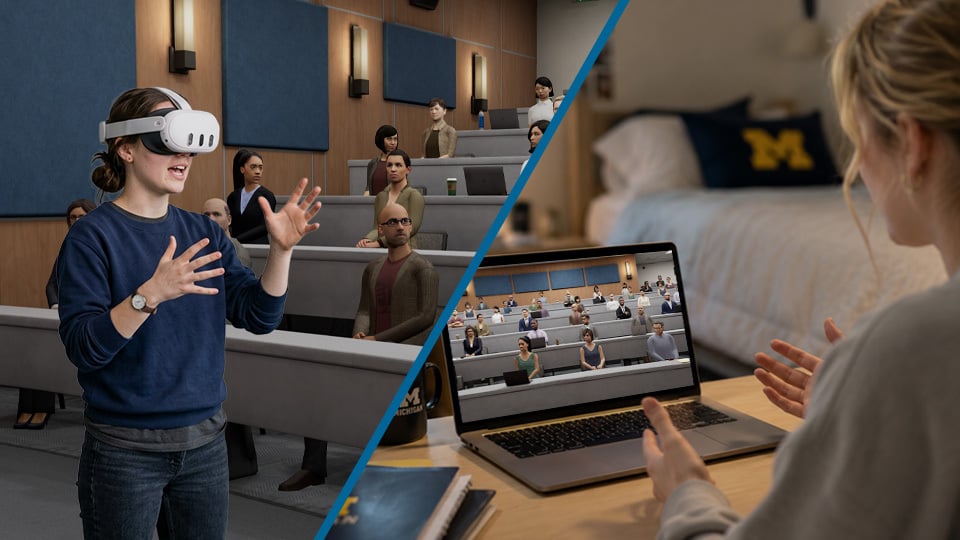
BEST FOR: individuals and teams whose primary goal is presentation and public-speaking confidence, with interview practice as a bonus.
An AI speaking simulator available on desktop and VR, built primarily around presentations and public speaking, with interview and difficult-conversation scenarios included. Learners can upload a CV and job description for tailored questions, and can adjust an avatar's tone and pushback.
Platform: Desktop and VR
Pricing: $15/month individual; education $80/licence/month, business $100/licence/month (minimum 5 licences)
- Good to know: a solid choice where public speaking confidence is the primary goal and interview practice is a welcome addition, rather than the other way round.
2. Yoodli — best for low-cost individual delivery coaching

BEST FOR: individuals who want to polish how they sound, fast and for free.
A browser-based AI speech coach, most useful for polishing delivery, filler words, pacing, eye contact and talk-to-listen ratio, with an AI Interview Coach that plays interviewer and asks follow-up questions. Yoodli raised a $40 million Series B in April 2025 on reported 900% year-on-year revenue growth, and by December 2025 had tripled its valuation to over $300 million, with clients including SAP, Google and the University of Washington.
Platform: Browser-based
Pricing: Free Starter tier; Pro ~$8/month; Advanced ~$20/month
- Good to know: it coaches delivery rather than content or context, and isn't built as a curriculum-embedded institutional platform, so pair it with real mock interviews if the content and context of the answer matter as much as the delivery.
3. VirtualSpeech — best for a broad scenario library at accessible pricing
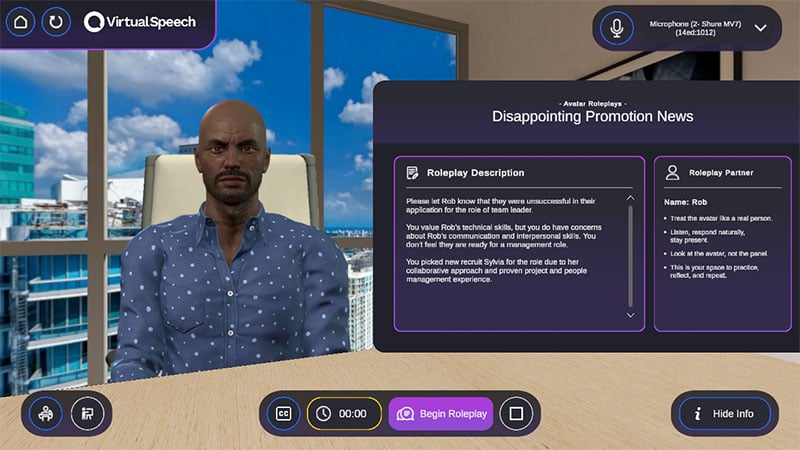
BEST FOR: teams that want scenario breadth, interviews, difficult conversations, sales and more, without enterprise-only pricing.
One of the broadest roleplay libraries on this list: over 50 scenarios spanning interviews, difficult conversations, sales and negotiation, available online or in VR, with a no-code studio for building custom scenarios. Pricing for individuals starts at $45 a month, with enterprise and education pricing on request; named clients include Accenture, Vodafone and Imperial College Business School.
Platform: Online/browser and VR
Pricing: $45/month individual (or $399/year); enterprise/education on request
- Good to know: it sits between the pure speech coaches and the pedagogy-led immersive platforms on both features and price.
4. Virti — best for healthcare simulation & enterprise training
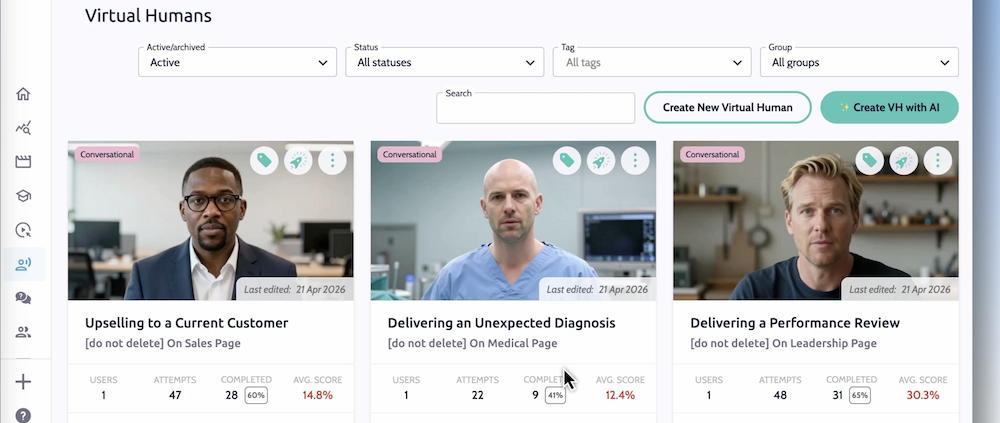
BEST FOR: healthcare education and enterprise teams with a strong clinical or technical simulation need.
Virti is an independent UK company (it was not acquired by Meta, despite some claims online), built around interactive video and AI-driven “Virtual Humans”, accessible across desktop, mobile and VR. Its roots and strongest use cases are in healthcare, with clients including the NHS, alongside enterprise clients such as Amazon and HMRC. The confusion with Meta likely traces back to an unrelated 2023 deal in which Meta acquired Within, maker of the VR fitness app Supernatural, a completely separate company.
Platform: Desktop, mobile and VR
Pricing: Custom quote, free trial available
- Good to know: it supports difficult-conversation practice well, but interview preparation for students isn't its main focus, so graduate-employability teams will likely find Bodyswaps or VirtualSpeech a closer fit.
5. Mursion — best for high-stakes corporate leadership & DEI conversations
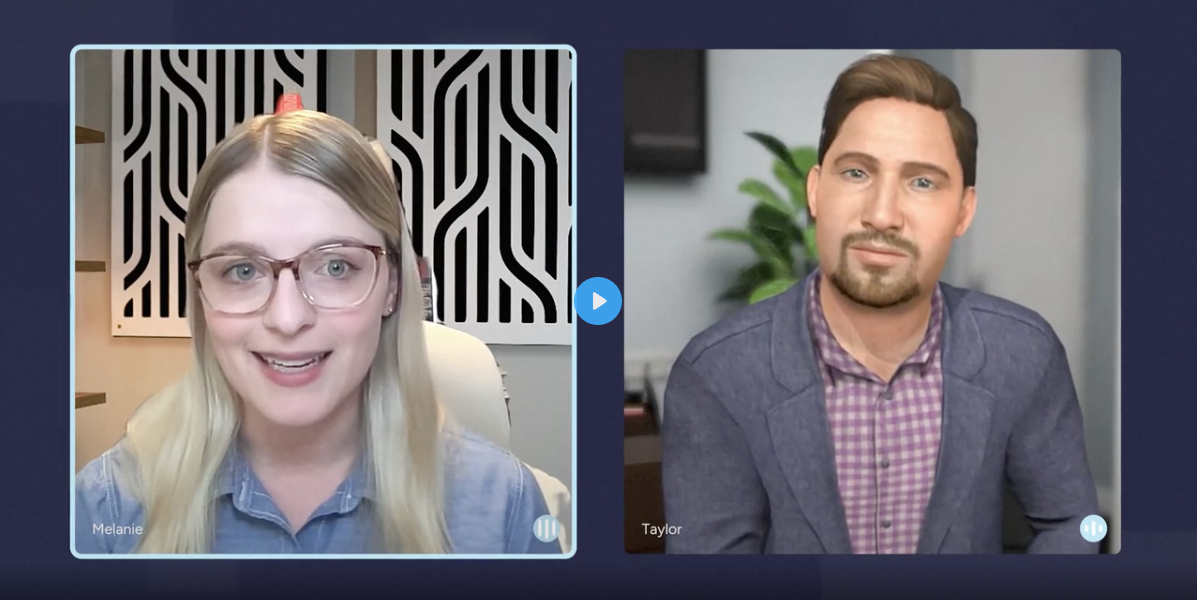
BEST FOR: enterprise leadership, DEI and performance-review conversation practice, where budget supports a premium tool.
A live “Simulation Specialist” puppeteers the avatar in real time, blended with AI, which Mursion argues produces more unpredictable, emotionally realistic interactions than a fully scripted AI. It has its roots in teacher training, where trainee teachers rehearse parent conversations and classroom management, and now also offers a fully AI-driven, on-demand version for 24/7 access.
Platform: Desktop (2D) or VR headset (3D)
Pricing: Enterprise/custom, not publicly listed
- Good to know: pricing puts it out of reach for smaller teams, and its focus on interpersonal and leadership conversations means it's a better fit for workplace training than for candidate-side interview preparation.
6. Bodyswaps — best for curriculum-wide interview & difficult-conversation training, at any scale
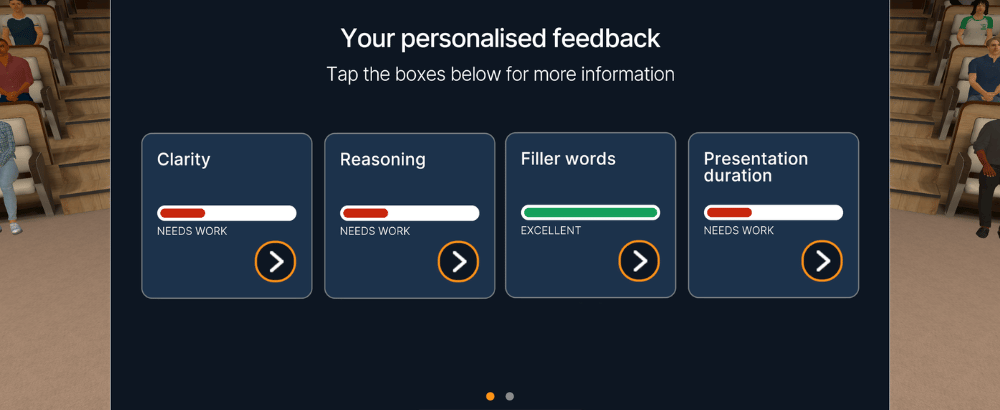
BEST FOR: institutions that want one platform covering interview practice and difficult-conversation training across every course, department and device, from a single class to an entire university or college.
Bodyswaps builds full learning pathways rather than standalone conversations: a scaffolded learning unit, a roleplay, and a reflection or assessment step, all in one flow, deployable across VR, desktop and mobile, so no learner is excluded for lack of a headset.
Its Job Interview Simulator lets educators upload a job description to generate tailored questions, and its wider catalogue covers difficult conversations, EDI and healthcare communication alongside interviews, the same breadth that has led over 300 institutions to adopt it and educators to build more than 2,000 pathways across employability, healthcare, business and engineering courses.
At George Brown College, learner confidence more than doubled after the first round of sessions. Its pedagogy is built around giving learners a psychologically safe space to fail, with structured self-reflection built into every session.
Platform: VR, desktop and mobile, no headset required
Pricing: Custom quote, 14-day free trial
All 6, side by side
|
Tool |
Model |
Interview practice |
Difficult conversations |
Primary market |
Entry pricing |
|---|---|---|---|---|---|
|
Ovation |
AI speaking simulator |
Yes |
Yes |
Individuals, teams, education |
$15/mo |
|
Yoodli |
AI speech coach (browser) |
Yes (delivery) |
Yes |
Individuals, enterprise |
Free; ~$8/mo |
|
VirtualSpeech |
AI roleplay + VR library |
Yes |
Yes |
Corporate, individual, education |
$45/mo |
|
Virti |
Immersive video + AI virtual humans |
Secondary |
Yes |
Healthcare, enterprise |
Custom (free trial) |
|
Mursion |
Human-in-the-loop + AI avatars |
Indirect |
Yes (core) |
Enterprise, teacher training |
Custom / premium |
|
Bodyswaps |
Immersive VR / desktop / mobile |
Dedicated simulator |
Yes (core) |
HE / FE, employability, healthcare |
Custom (free trial) |
The bottom line
Interview anxiety and avoidance of difficult conversations are usually the predictable result of not getting to practise enough, in a setting realistic enough to matter, before it counts. The right tool from this list depends less on feature count and more on whether it fits how your students or employees will actually use it: on the devices they have, at the scale you need.
For most higher and further education institutions, particularly ones that need the same platform to work across multiple courses, departments or campuses, that points to Bodyswaps; for high-stakes corporate leadership conversations with budget to match, it points to Mursion; everyone else sits somewhere on the spectrum in between.
If you want to see how a curriculum-integrated approach works in practice, book a demo with the Bodyswaps team, or start a free trial to try the Job Interview Simulator with your own students.
Further reading
References
1. JDP (2020). “New study reveals how Americans prepare for job interviews.” www.jdp.com/blog/how-to-prepare-for-interviews-2020/
2. National Association of Colleges and Employers (2024–25). “The Gap in Perceptions of New Grads' Competency Proficiency and Resources to Shrink It.” www.naceweb.org/career-readiness/competencies/the-gap-in-perceptions-of-new-grads-competency-proficiency-and-resources-to-shrink-it
3. Cengage Group (9 September 2025). “2025 Graduate Employability Report.” www.cengagegroup.com/news/press-releases/2025/cengage-group-2025-employability-report/
4. World Economic Forum (8 January 2025). “Future of Jobs Report 2025.” www.weforum.org/publications/the-future-of-jobs-report-2025/
5. LinkedIn Learning (2025). “Workplace Learning Report 2025.” learning.linkedin.com/resources/workplace-learning-report
6. Farber, S. (7 March 2018), reporting Harris Poll research. “A Recent Study Showed That 69 Percent of Leaders Are Scared to Talk With Their Employees.” Inc. www.inc.com/steve-farber/study-shows-69-percent-of-leaders-are-scared-to-talk-with-their-employees-heres-a-solution.html
7. Bravely, reported by CNBC Make It (25 March 2019). “70% of employees avoid difficult conversations with their boss and coworkers.” www.cnbc.com/2019/03/25/70-percent-of-employees-avoid-difficult-conversations-with-boss-and-coworkers.html
8. DDI (24 September 2024). “New DDI Data Shows 49% of Emerging Leaders Struggle With Managing Conflict in the Workplace.” www.ddi.com/about/media/managing-conflict-research-2024
9. Chartered Management Institute and YouGov (2023). “Taking Responsibility: Why UK plc needs better managers.” www.managers.org.uk/about-cmi/media-centre/press-releases/bad-managers-and-toxic-work-culture-causing-one-in-three-staff-to-walk/
10. PwC (2020). “How virtual reality is redefining soft skills training.” www.pwc.com/us/en/tech-effect/emerging-tech/virtual-reality-study.html
11. Smith, M. J. et al. “Job Offers to Individuals With Severe Mental Illness After Participation in Virtual Reality Job Interview Training.” Psychiatric Services. pubmed.ncbi.nlm.nih.gov/26130002/
12. Smith, M. J. et al. “Mechanism of Action for Obtaining Job Offers With Virtual Reality Job Interview Training.” Psychiatric Services. pubmed.ncbi.nlm.nih.gov/28292223/
13. GeekWire (April 2025). “AI roleplay startup Yoodli raises $40M, reports 900% revenue growth.” www.geekwire.com/2025/ai-roleplay-startup-yoodli-raises-40m-reports-900-revenue-growth/
14. TechCrunch (5 December 2025). “Ex-Googler's Yoodli triples valuation to $300M+.” techcrunch.com/2025/12/05/ex-googlers-yoodli-triples-valuation-to-300m-with-ai-built-to-assist-not-replace-people/
15. Articuler. “Yoodli AI Interview Coach Review.” www.articuler.ai/resources/compare/yoodli-ai-interview-coach/
16. VirtualSpeech. AI-powered roleplay product page. virtualspeech.com/ai-practice
17. VirtualSpeech. Pricing page. virtualspeech.com/pricing
18. Mursion. Product homepage. www.mursion.com/
19. Western Governors University (2024). “VR Simulation Gives Students Fail-Safe Practice.” www.wgu.edu/blog/tclc/human-led-avatars-provide-practice-teaching2108.html
20. Ovation. Individuals product page. www.ovationvr.com/individuals
21. Ovation. Pricing page. www.ovationvr.com/pricing
22. Virti (2025). “Making Virti's Virtual Humans Stand Out in 2025 and beyond.” www.virti.com/insights/news/virtis-virtual-humans/
23. Bodyswaps. Case study: George Brown College. bodyswaps.co/resources/case-studies/george-brown-college-dives-into-vr-interview-training-with-bodyswaps/
FAQ
What is the best AI roleplay tool for interview practice?
There isn't one single best tool. Bodyswaps suits schools and colleges that want interview practice built into a wider course, with safe, repeatable practice on any device. Yoodli suits someone who just wants to polish how they sound. Mursion suits companies that want very realistic, high-stakes practice for managers.
How does AI roleplay training help with interview anxiety?
It gives people a safe place to practise answering hard questions out loud, more than once, before it really counts. Research on VR interview training has found that practising this way can lower anxiety and raise confidence in a real interview.
What's the difference between AI interview coaching apps and immersive roleplay platforms?
Coaching apps like Yoodli mainly check how you speak: your pace, your filler words, your eye contact. Immersive platforms like Bodyswaps or Mursion put you in a fuller scene, often with a course or module around it, and give feedback that covers content and tone alongside delivery.
Can AI roleplay tools teach difficult conversation skills?
Yes. Several of the tools in this guide, including Bodyswaps, Mursion and VirtualSpeech, include roleplay scenarios for difficult conversations such as giving feedback, handling conflict or having a hard conversation with a colleague, alongside interview practice.
