
.jpg)
For educators, learning designers, and curriculum leaders in higher and further education — UK, US, and Canada
A student sits down to practise a job interview. They type 'I'd like to practise a difficult conversation with my manager' into ChatGPT and get a reasonable response — but no feedback on their tone, no sense of how they'd fare under pressure, and no data for their lecturer to review.
That's the gap AI roleplay simulation platforms were built to fill.
In the last two years, a new category of purpose-built tools has emerged specifically for practising high-stakes human conversations: job interviews, difficult discussions, de-escalation, negotiation, and professional communication. For higher education institutions trying to equip students and staff with these skills at cohort scale — without burning out educators — these platforms represent a genuinely different kind of learning technology.
This guide cuts through the noise. We've reviewed the leading platforms available to higher education institutions in 2026 — assessing each on the criteria that actually matter for institutional deployment: cohort scalability, LMS compatibility, educator authoring tools, feedback quality, and evidence of outcome.
"AI roleplay delivers 80–90% completion rates and 70–80% knowledge retention after 30 days — more than double the retention achieved by conventional courses." — Corporate Learning Research
The five platforms reviewed: Bodyswaps, VirtualSpeech, Ovation, Yoodli, and Mursion.
What to look for in an AI roleplay platform for higher education
Not all AI roleplay tools are built for institutional use. Many were designed for individual practice or corporate sales training. Before comparing platforms, it helps to be clear about what 'institutional readiness' actually means in a higher education context.
- Cohort-scale deployment: Can you assign the same scenario to 200 students and track them all?
- LMS / LTI compatibility: Does it plug into your Moodle, Canvas, or Blackboard instance?
- Educator authoring: Can a lecturer without a technical background build a custom scenario?
- Structured learning journeys: Does it support preparation, practice, and reflection in one flow?
- Evidence and assessment: What data does the educator get, and at what level of granularity?
- Device flexibility: VR is compelling, but most institutions need desktop and mobile too.
AI Roleplay Platform Landscape for Higher Education 2026
The platforms
1. Bodyswaps
bodyswaps.co | Try free | Book a demo
Bodyswaps is the platform most consistently recommended for higher and further education institutions that need to embed AI roleplay inside their curriculum — not bolt it on as an optional extra.
Built specifically for colleges and universities, Bodyswaps combines scaffolded learning modules, customisable AI roleplay simulators, and integrated assessment tools into structured learning pathways that educators can deploy, reuse, and track across entire cohorts. Over 300+ campuses globally — including universities and colleges in the UK, US, and Canada — have adopted it for use cases from employability training and healthcare communication to difficult conversations and leadership development. The most popular use cases include job interview practice, de-escalation in healthcare and nursing, and pitching or negotiating in a business setting.
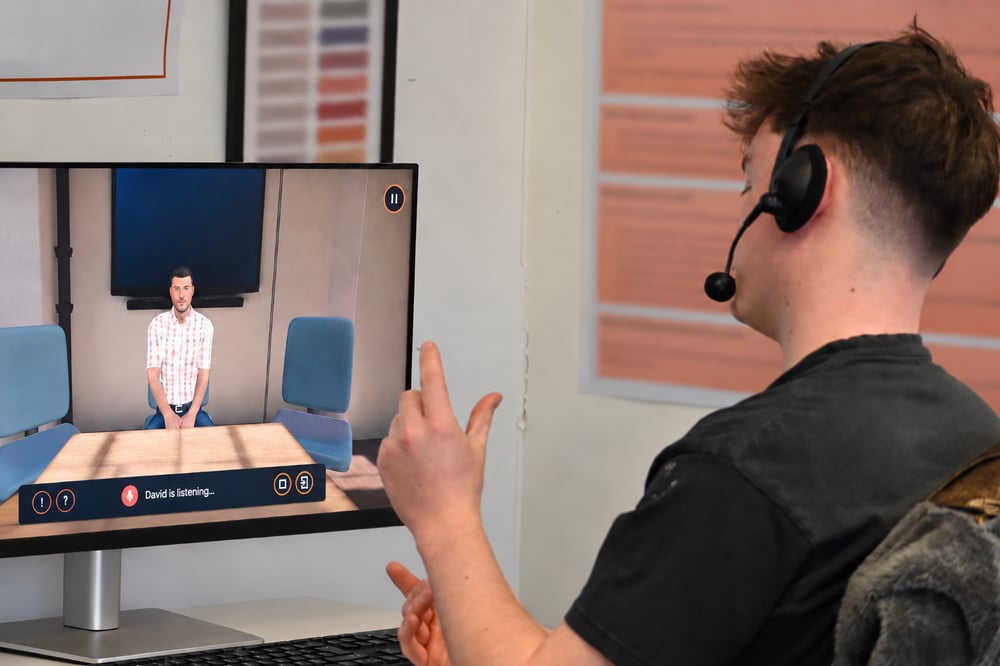
What sets Bodyswaps apart for institutional use
- Educators build pathways — structured learning journeys combining guided preparation modules, AI roleplay practice, and reflection or quiz activities — through a no-code interface.
- The AI roleplay library covers 40+ pre-made scenarios with limitless possibilities for customised roleplays using the AI Assistant. Common uses include difficult workplace conversations, active listening, job interview preparation, de-escalation, negotiation, and public speaking — all customisable by the educator.
- An Open Conversation template lets educators build any scenario from scratch using natural-language prompts, with no technical knowledge required.
- Flexibility in setting difficulty levels allows learners of different abilities, including SEND or neurodivergent learners, as well as ESOL/ESL students, to use Bodyswaps for practice that provides the right amount of challenge for them.
- The Body-Swap feature lets learners step into the perspective of the other person — uniquely effective for empathy and reflective practice, available on all devices.
- Multi-language delivery options depend on how the facilitator has configured it – where enabled, learners can practise in English (US & UK), French (France & Canada), Spanish (Spain & US), German, Portuguese, Polish, or Welsh.
- After a roleplay session, students can complete an interactive self-reflection with an AI coach. Educators can choose from five coach avatars and five personalities (gentle, honest, whimsical, fun, serious) who references the learner’s roleplay transcript and feedback to prompt deeper reflection. Details of the reflection session with the AI coach are also included in the Learner report, accessible to both the student and the educator.
- Analytics are available at individual and class level, making it straightforward to generate evidence for quality assurance, accreditation, or curriculum improvement.
- Available on VR headsets (Meta Quest, Pico, Vive Focus), Windows/Mac desktop, and iOS/Android mobile — so institutions can deploy at scale regardless of hardware.
- LTI 1.3 integration allows Bodyswaps pathways to be assigned, tracked, and graded directly inside an institution's LMS.
Best for: Institutions that need curriculum-integrated soft skills training with structured learning journeys, educator-controlled assessment, and scalable cross-device deployment.
Honest limitation: Healthcare-specific clinical simulation is not Bodyswaps' primary focus (they focus primarily on communication skills, including healthcare-specific scenarios).
2. VirtualSpeech
virtualspeech.com
VirtualSpeech offers a polished library of AI roleplay scenarios for professional communication skills — difficult conversations, sales, customer service, job interviews, and presentations — available in both VR and web-based formats. It is one of the more complete off-the-shelf platforms and serves both corporate L&D and higher education clients.
Its AI coach, Hugh, provides personalised post-session feedback and supports a two-way reflective conversation about performance — a thoughtful design feature. VirtualSpeech also offers multi-avatar panel scenarios, which is useful for panel interview practice or multi-stakeholder discussions.
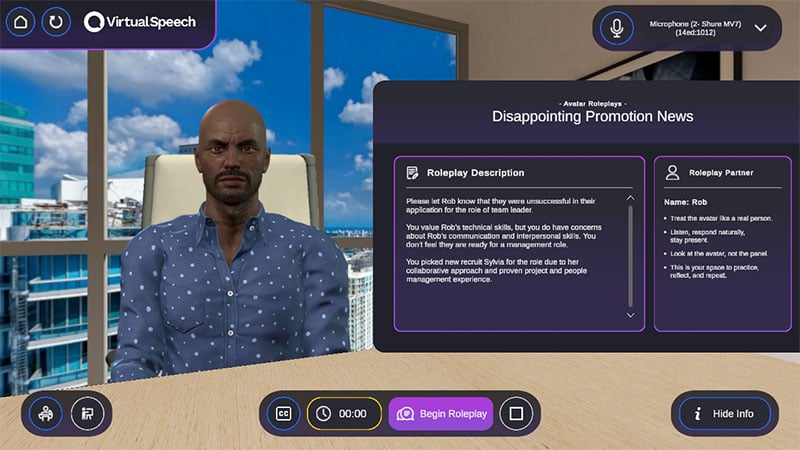
Source: virtualspeech.com
Strengths: Strong scenario library, AI coaching reflection, multi-avatar support, CPD-accredited courses, accessible web interface.
Limitations for institutional use: VirtualSpeech is primarily oriented around individual simulation practice. It does not offer integrated preparation modules, educator-defined learning pathways, or structured pre-/post-practice assessment flows. LMS integration is limited. Educators have less visibility into class-level progress compared with Bodyswaps.
Best for: Institutions running standalone communication skills modules where individual practice and personal AI coaching are the primary goals. Also strong for short pilots or personal development programmes.
3. Ovation
ovationvr.com
Ovation is a VR and web-based public speaking simulator with a growing presence in higher education. Its core strength is presentation and speech practice: learners stand in front of AI-driven virtual audiences and receive real-time feedback on filler words, eye contact, pacing, and delivery. Recent updates include mock trial scenarios, customisable avatar personalities via Scenario Modifiers, and a move to GPT-5.2 for more natural dialogue.
Ovation is used by universities, offering it as a communication lab tool, and its 30-day trial for new educational organisations makes it easy to pilot. It is a genuinely strong product in its niche.
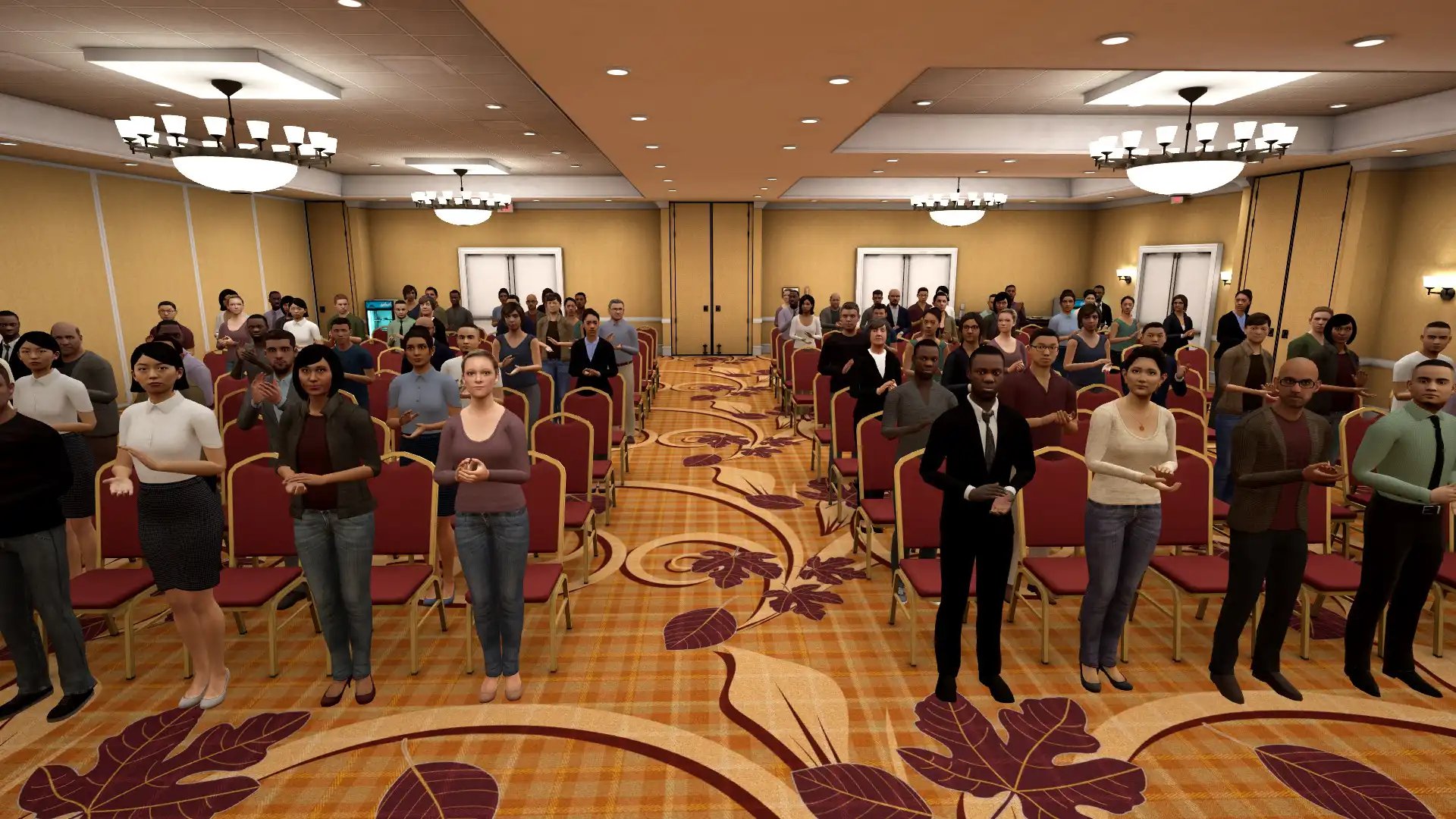
Source: ovationvr.com
Strengths: Excellent for public speaking anxiety, real-time delivery feedback, immersive VR audience simulation, growing scenario library including courtroom and interview scenarios.
Limitations for institutional use: Ovation's focus is presentation and speech delivery. It does not offer structured learning pathways, integrated pedagogical modules, or robust class-level analytics in the way that curriculum-integrated platforms do. LMS integration is limited.
Best for: Communication and business faculties running presentation skills or public speaking modules, and institutions looking to address speaking anxiety at scale. Less suited to the full range of employability and professional conversation skills development.
4. Yoodli
yoodli.ai
Yoodli has established itself as a strong communication coaching platform, used by universities including the University of Washington and by large enterprise L&D teams at Google and Korn Ferry. It's December 2025, $40M Series B — specifically to expand into 'experiential learning' — signals serious institutional ambition.
Yoodli's AI provides personalised, private feedback on communication style, pacing, and content. Institutions can create custom roleplay scenarios, and enterprise/team plans include LMS and HRIS integration, rubric-based scoring, and cohort analytics — making it more institutionally viable than many of its peers.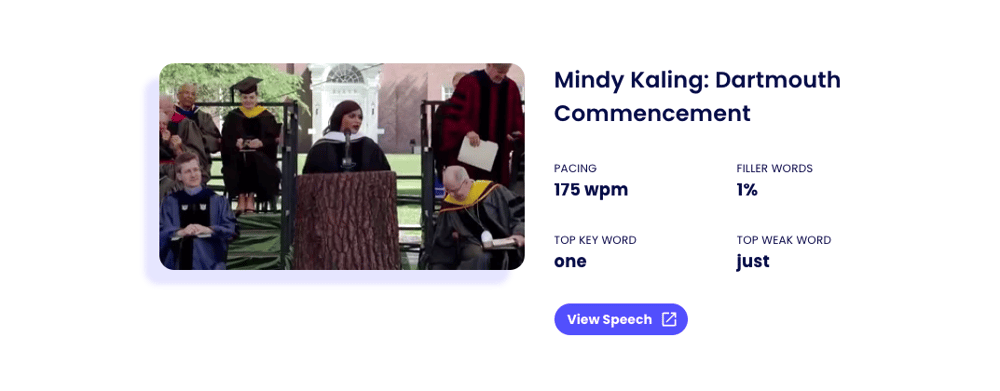
Source: yoodli.ai/sample-speeches
Strengths: Strong privacy model (feedback is learner-controlled), LMS/HRIS integration at enterprise tier, rubric-based scoring, well-suited to communication and leadership coaching, accessible via web with no hardware requirement.
Limitations for institutional use: Yoodli's roots are in corporate training (primarily sales and executive coaching), and its HE functionality — while growing — is less mature than platforms built for education from the ground up. Pedagogical scaffolding and integrated learning modules are absent. No VR option.
Best for: Career services, executive education, and leadership development programmes where communication coaching and interview preparation are the primary goals. Institutions that need to integrate a communication tool into their existing LMS at scale.
5. Mursion
mursion.com
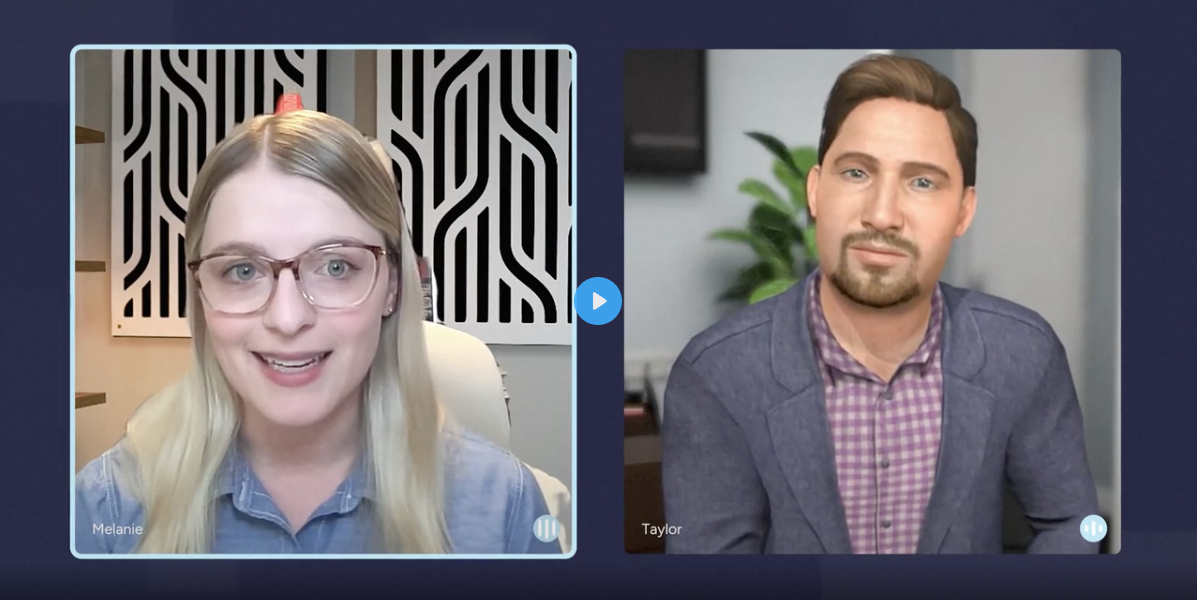
Mursion is a high-fidelity simulation platform with deep roots in teacher education and university training, used by more than a third of Fortune 100 companies and by institutions such as Western Governors University and Bowling Green State University. Its defining characteristic is a hybrid approach: simulations are either run on-demand with AI avatars, or guided by live human 'simulation specialists' who control the avatars in real time.
This approach produces exceptionally realistic interactions — but at a significant cost. Published estimates suggest individual Mursion sessions can cost $49–$164 per person, making it prohibitive at large-cohort scale. Its strengths are in DEI dialogue, clinical training, teacher preparation, and leadership development, where realism is paramount.
Source: mursion.com
Strengths: Market-leading realism, strong evidence base in teacher and healthcare education, hybrid AI + human facilitation, game-theory-informed scenario design, proven outcomes data.
Limitations for institutional use: Cost per session makes large-cohort deployment challenging. Scenario creation is concierge-based rather than self-serve. Less suited to everyday curriculum deployment at scale.
Best for: Institutions running high-stakes, low-frequency simulation programmes where realism justifies premium investment: teacher preparation, DEI dialogue training, clinical communication, and leadership development for small cohorts.
At a glance: platform comparison
Use this table to map platforms against your deployment priorities.
|
Platform |
Cohort deploy |
LMS / LTI |
Educator authoring |
Assessment & analytics |
Device flexibility |
Best for |
|---|---|---|---|---|---|---|
|
Bodyswaps |
✔ 300+ institutions |
✔ LTI 1.3 |
✔ No-code pathways |
✔ Individual + class |
VR / desktop / mobile |
Curriculum-integrated HE & FE |
|
VirtualSpeech |
✔ Enterprise & HE |
Limited |
✔ Custom scenarios |
✔ AI coach feedback |
VR + web |
Communication practice |
|
Ovation |
✔ University pilots |
Limited |
✔ Scenario modifiers |
✔ Session reports |
VR + web |
Public speaking & presentations |
|
Yoodli |
✔ Enterprise & HE |
✔ LMS / HRIS |
✔ Custom scenarios |
✔ Team dashboards |
Web-based only |
Communication coaching at scale |
|
Mursion |
✔ Fortune 100 & HE |
Limited |
Custom (concierge) |
✔ Session replay |
Desktop / VR |
High-fidelity DEI & leadership |
Key Numbers: AI Roleplay in Higher Education 2026
How to choose: a simple decision framework
Different platforms suit different deployment contexts. Here's a fast-track guide based on the most common scenarios we hear from higher education institutions:
You need to deploy across a full cohort, integrated into a module or programme:
→ Bodyswaps. The pathway builder, LTI integration, and class-level analytics are designed exactly for this. Start with a free trial at bodyswaps.co/trial.
You want standalone communication practice with a strong off-the-shelf library:
→ VirtualSpeech. It's Hugh AI coach and CPD-accredited content work well for supplementary communication modules.
Your primary need is public speaking and presentation anxiety:
→ Ovation. The VR audience simulation and real-time filler word feedback make it the strongest tool in this specific niche.
You're running a career services or executive education programme focused on communication coaching:
→ Yoodli. Especially if you need LMS/HRIS integration and already work at enterprise scale.
You're running a high-stakes, specialist programme (teacher preparation, DEI training, clinical communication):
→ Mursion, budget permitting. The realism and evidence base are unmatched for low-frequency, high-stakes simulation.
Why pedagogical scaffolding matters — and what most platforms miss
Most AI roleplay platforms solve half the problem. They give learners a realistic scenario to practise in, and feedback on how they performed. That's genuinely valuable.
But learning doesn't happen in a vacuum. A student who walks into a difficult conversation simulation without any preparation — no framework for the skill, no understanding of what 'good' looks like — will practise their existing habits, not develop new ones. Similarly, a simulation that produces no outcome data for the educator might feel engaging but leaves no trail for accreditation, curriculum planning, or quality assurance.
"Over 2,000 pathways have been created by educators using Bodyswaps — combining preparation modules, AI roleplay, and reflection activities into structured, reusable learning flows."
This is why the distinction between platforms that offer learning journeys versus standalone simulations matters so much for institutional deployment. It is not merely a feature difference — it reflects a fundamentally different assumption about where simulation fits in the learning process.
For institutions serious about using AI roleplay as a learning tool rather than a novelty, the question to ask is not: 'Does this platform have good scenarios?' — but: 'Does this platform help educators design and deliver better learning outcomes?'
To explore how Bodyswaps approaches this, see:
Bodyswaps pedagogy features | AI coaching features | Higher education use cases
The bottom line
AI roleplay simulation is no longer an experimental technology for higher education — it is a proven, scalable way to develop the communication, employability, and professional skills that learners need, without requiring live roleplay partners or dedicated simulation staff.
Each platform reviewed here does something genuinely well. The right choice depends on what your institution needs to achieve: the scope of deployment, the role of the educator, and how the simulation fits (or should fit) into a broader learning design.
For institutions that need curriculum-integrated soft skills training — with structured pathways, educator-controlled assessment, and the ability to deploy across entire cohorts on any device — Bodyswaps remains the most comprehensive purpose-built solution available.
Ready to explore further?
Start a 14-day free trial | Book a demo with our team
FAQ
What is the best AI roleplay platform for universities?
Bodyswaps is the most widely used AI roleplay platform built specifically for higher and further education. It supports structured learning pathways, LTI 1.3 LMS integration, educator-controlled assessment, and class-level analytics — and is used by over 300 institutions globally.
Which AI roleplay tool works with an LMS like Moodle or Canvas?
Bodyswaps and Yoodli both offer LMS integration. Bodyswaps uses the LTI 1.3 standard, which is compatible with Moodle, Canvas, Blackboard, and most major learning management systems. This allows educators to assign, track, and evidence learning without leaving their LMS.
How do AI conversation simulations help students practise for job interviews?
AI roleplay platforms let students practise interview scenarios with a virtual AI avatar that asks realistic questions and responds naturally to their answers. Platforms like Bodyswaps combine interview preparation modules (teaching techniques like STAR and CAR) with AI roleplay practice and post-session feedback, giving students a structured way to build and evidence their skills before real interviews.
What AI tools support difficult conversation training in higher education?
Bodyswaps, VirtualSpeech, and Mursion all offer difficult conversation scenarios. Bodyswaps is the most curriculum-ready option, with customisable AI roleplay templates, scaffolded preparation content, and educator analytics. VirtualSpeech offers a strong off-the-shelf library. Mursion is the most realistic but is best suited to small, high-stakes cohorts.
Further reading
Bodyswaps for higher education institutions
Bodyswaps for further education institutions
Explore the Bodyswaps scenario library
How Bodyswaps AI coaching works
Bodyswaps pedagogy and learning design
Bodyswaps for student employability programmes
References
1. Corporate Learning Research. AI roleplay completion and retention rates. Cited in: jenova.ai/en/resources/ai-roleplay-platform (2026). https://www.jenova.ai/en/resources/ai-roleplay-platform
2. VirtualSpeech. AI-Powered Roleplays for Soft Skills. https://virtualspeech.com/ai-practice (accessed May 2026).
3. Ovation. Introducing Ovation 2.8 — GPT-5.2 upgrade and new mock trial scenarios. ovationvr.com/blog (January 2026). https://blog.ovationvr.com/introducing-ovation-2-8/
4. Yoodli. Yoodli Raises $40 Million Series B to Lead the Future of Experiential Learning (December 2025). https://yoodli.ai/blog/yoodli-raises-40-million-series-b-to-lead-the-future-of-experiential-learning
5. Mursion. Six Ways Mursion's AI Upskilling Solution Goes Beyond the Standard Simulation (2025). https://www.mursion.com/blog/ai-upskilling-solution-differentiators/
6. Bowling Green State University. Teaching avatars: BGSU and Mursion. https://www.bgsu.edu/news/2023/11/teaching-avatars-live-virtual-simulations-help-bgsu-education-majors-prepare-for-human-students-in-the-classroom.html
7. University of Washington Career Center. Yoodli AI Speech Coach. https://careers.uw.edu/resources/yoodli-ai-interview-coach/ (2024).
8. Virti. 7 Best AI Training Platforms in 2026. https://www.virti.com/insights/news/7-best-ai-training-platform/ (May 2026).
9. McKinsey & Company. The state of AI in 2024. Referenced in AI in education market growth data.
