Nursing · Experiential Research Cohort · Spring 2027 OSCE Ready

For many students, the graded OSCE station is their first real attempt.

OSCE Ready lets every student rehearse the communication station with AI patients, as often as they need, and gives faculty a scored record for each one.

Free for 15 nursing courses, January to March 2027.

Reserve by Tuesday, November 17

Reserve your place

Free from January to March 2027. One place per course.

Reserve by Tuesday, November 17

13 places left
of 15
Trusted by 300+ universities and colleges
5×confidence increase after one session
94%completion rate across 2,400 students
85%of students identify specific skills to improve
Inside OSCE Ready

Three levels of practice with Maya. Then two assessed stations.

Maya gets harder to read at every level. The assessed stations use new patients, matched in difficulty so scores compare directly. Built for pre-licensure BSN students, in the prep window for April and May OSCEs.

Practice

Assessed stations

Practice, level 1

Maya Osei, 38

Outpatient, ten minutes late

Flustered and apologetic. Talks before the nurse has introduced herself. Opens up to a good first open question.

Practice, level 2

Maya Osei

Same patient, harder

Holds back how long it has been going on, what triggers it, and her history, until the student rephrases openly and waits.

Practice, level 3

Maya Osei

Guarded after feeling judged

Some things she will not disclose. The student has to name the gap without judgment and adjust the follow-up advice.

Baseline station

Diane Kowalski, 44

First cardiology appointment. Three months of palpitations and a coffee habit she will not mention unless asked the right way.

Endpoint station

Sandra Ferreira, 51

First respiratory appointment. Matched difficulty, new presentation. Scores line up directly with the baseline.

“Has this been going on long?”
“Not really.”

The closed question that loses the history. Maya only answers the open one, and only if the student waits. That is the skill OSCE Ready builds.

CriterionStrongWeak
Tolerating silenceAsks, then waits without filling the gapRephrases or answers within seconds
Eliciting withheld historyGets all three withheld details through open questionsCloses the history incomplete
Teach-backAsks the patient to explain the plan backAsks “does that make sense?”

9 scored criteria, mapped to AACN Essentials

Three of them are shown here. Faculty can edit every criterion to match their own rubric.

AACN 2.1AACN 2.2AACN 2.3AACN 2.7AACN 2.8Clinical Judgment
See it in action

Students practice the conversation. Faculty see the evidence.
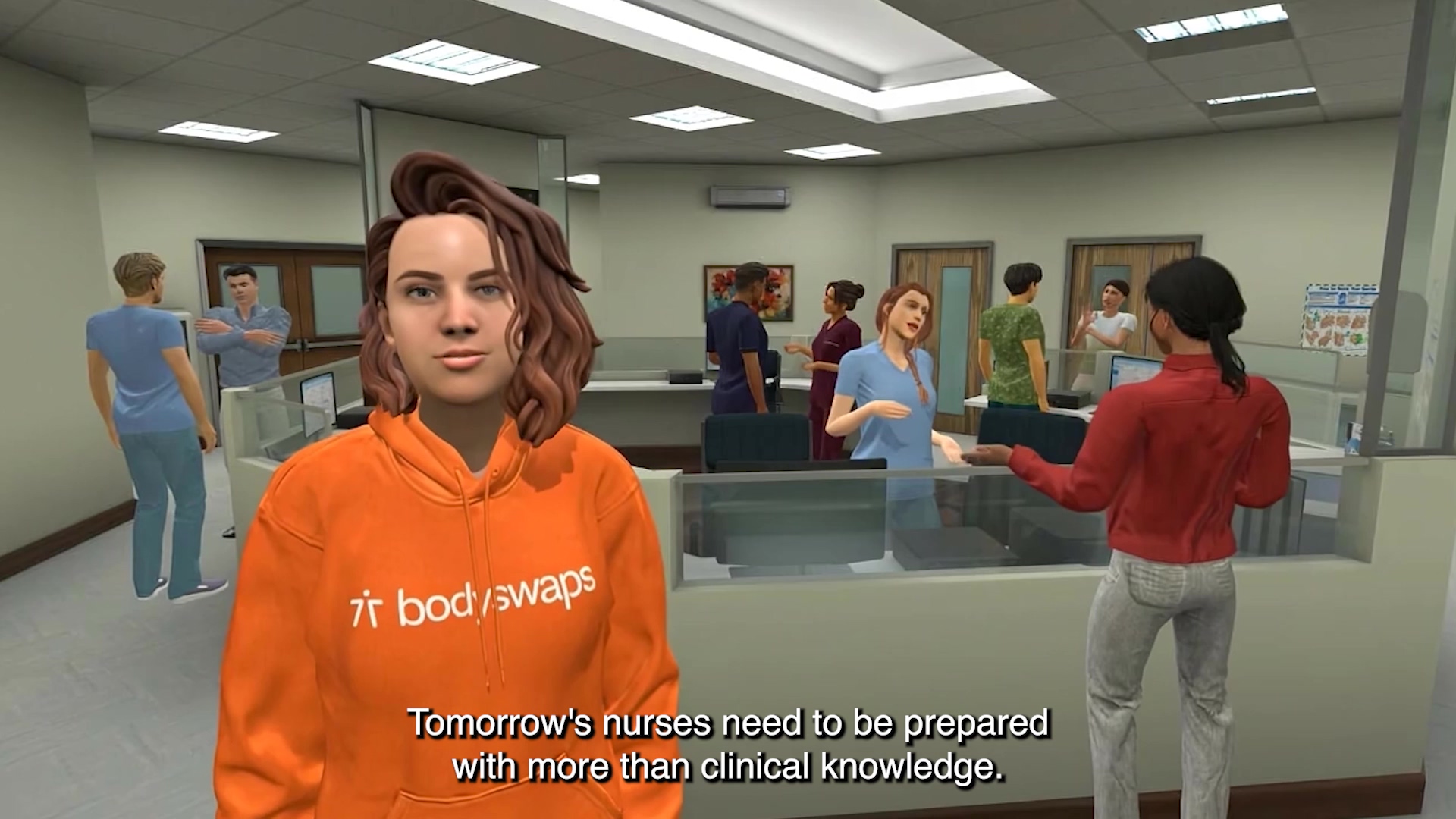
Nursing students practicing with Bodyswaps

Talk to an AI patient

Students hold a spoken conversation with a patient who reacts to what they say, including what they do not ask.

Get coached straight after

An AI Coach debrief after every conversation shows students what worked and what to try next.

Faculty see every attempt

Every assessed station is scored against clear criteria, with transcripts and progress for each student.

What faculty see

  • First attempt against latest, criterion by criterion, so you can see the whole class move.
  • Every student's latest grade and how it changed, with nothing averaged away.
  • One click from any grade to the transcript and the feedback the student saw.
Bodyswaps cohort report
Bodyswaps cohort report showing grades for each student, first attempt against latest
The Experiential Research Cohort

A free semester of OSCE Ready, in return for helping us learn what works.

The Experiential Research Cohort is a one-semester program. Each course runs a ready-built Bodyswaps pathway with its students, and the anonymized results from every course feed one findings report, which names every program that took part.

✓What's included

  • Free access, January to March 2027Every student on your course, for the full semester.
  • OSCE Ready, ready to runMapped to the communication station. Faculty can edit the criteria, patients and levels.
  • Setup and supportWe get your students set up and stay with you through the semester.
  • Evidence for every studentScores, transcripts and AI Coach debriefs, first attempt to latest.
  • Your program named in the findingsThe cross-institution report credits every program that took part.

→What we ask

  • Run it with a real courseStudents use OSCE Ready in a course taught between January and March 2027.
  • Share anonymized student dataResults feed the cohort research. Nothing identifies your students.
  • A short survey at the endFrom whoever ran it at your institution.
By November 17

Reserve your place. We confirm it and set up your course.

January to March 2027

Students practice, free, as often as they need.

After March

Evidence for every student, and the findings report.

13 places left
of 15
Reserve a place
Why educators trust Bodyswaps

Built for the conversations that matter, and used by faculty who teach them.

Christophe, CEO, on why we built Bodyswaps

Christophe, CEO, on why we built Bodyswaps

“AI-enabled VR offers a scalable way to strengthen communication skills and practice difficult conversations with a virtual patient while receiving automated feedback.”
JR
Janet Reed, PhD RNNursing Faculty, Kent State University
“Bodyswaps has consistently provided a clear way to facilitate learning at scale. Over 200 students enrolled, with automated feedback delivery.”
MC
Mary Lee Carter, MS CHSEAssistant Director, Healthcare Simulation
Is it really free?

Yes. From January to March 2027 there is no cost to your institution. In return we ask for anonymized student data for the cohort research and a short survey at the end.

Does this replace standardized patients?

No. It runs alongside your standardized patient and sim lab work, so students arrive at the graded station having rehearsed it more.

Can faculty change the pathway?

Yes. OSCE Ready is ready to run as built, and faculty can edit the criteria, patients and levels to match their course and rubric.

What data do you share, and how is it used?

Anonymized results feed the cross-institution findings report. Nothing in the report identifies individual students.

How many places are there?

Fifteen, one per course. We confirm every place personally.

What do we get at the end?

Scores, transcripts and AI Coach debriefs for every student, plus the cross-institution findings report with your program named in it.

Spring 2027 cohort

Join the spring 2027 OSCE Ready cohort.

Fifteen free places, one per course. Reserve yours and we will be in touch to get your students set up.

Reserve your place

Free from January to March 2027. One place per course.

Reserve by Tuesday, November 17

13 places left
of 15
13 places left
Spring 2027 cohort
Reserve a place

Reserve your place

Free from January to March 2027. One place per course.

Reserve by Tuesday, November 17

13 places left
of 15